
Lawful Redundancy in New Zealand | McKenzie Law

Ron Mckenzie | May 14, 2026
Step-by-step guide to protecting yourself from the moment you receive that letter
The exact process your employer must follow — and what to do when they don’t
You’ve been told your role is being disestablished. Maybe it came with a polished letter about “business restructuring” or “organisational efficiencies.” Maybe it came with almost no warning at all.
Whatever the delivery, the impact is the same: your livelihood, your routine, and your sense of security have been shaken.
But here is what many New Zealand employees don’t know in that moment — the word “redundancy” is not a shield your employer can hide behind. A redundancy is a legal process. It has requirements. And when those requirements aren’t met, it becomes an unjustified dismissal.
This guide explains exactly what your employer is legally obligated to do before making you redundant — and what your options are when they don’t do it.
What makes a redundancy legal in New Zealand?
Under the Employment Relations Act 2000, a redundancy is treated by the law as a form of dismissal. That means it must meet the same standard of justification as any other dismissal.
A redundancy must be substantiated with valid, documented reasons; transparent, with genuine consultation and time to respond; and non-discriminatory, with selection following fair criteria rather than personal bias.
There are two tests an employer must satisfy. The first is substantive: is there a genuine business reason why this role is no longer needed? The second is procedural: did they follow a fair process to get to that decision?
Failing either test opens the door to a personal grievance for unjustified dismissal.
The process your employer must follow — step by step
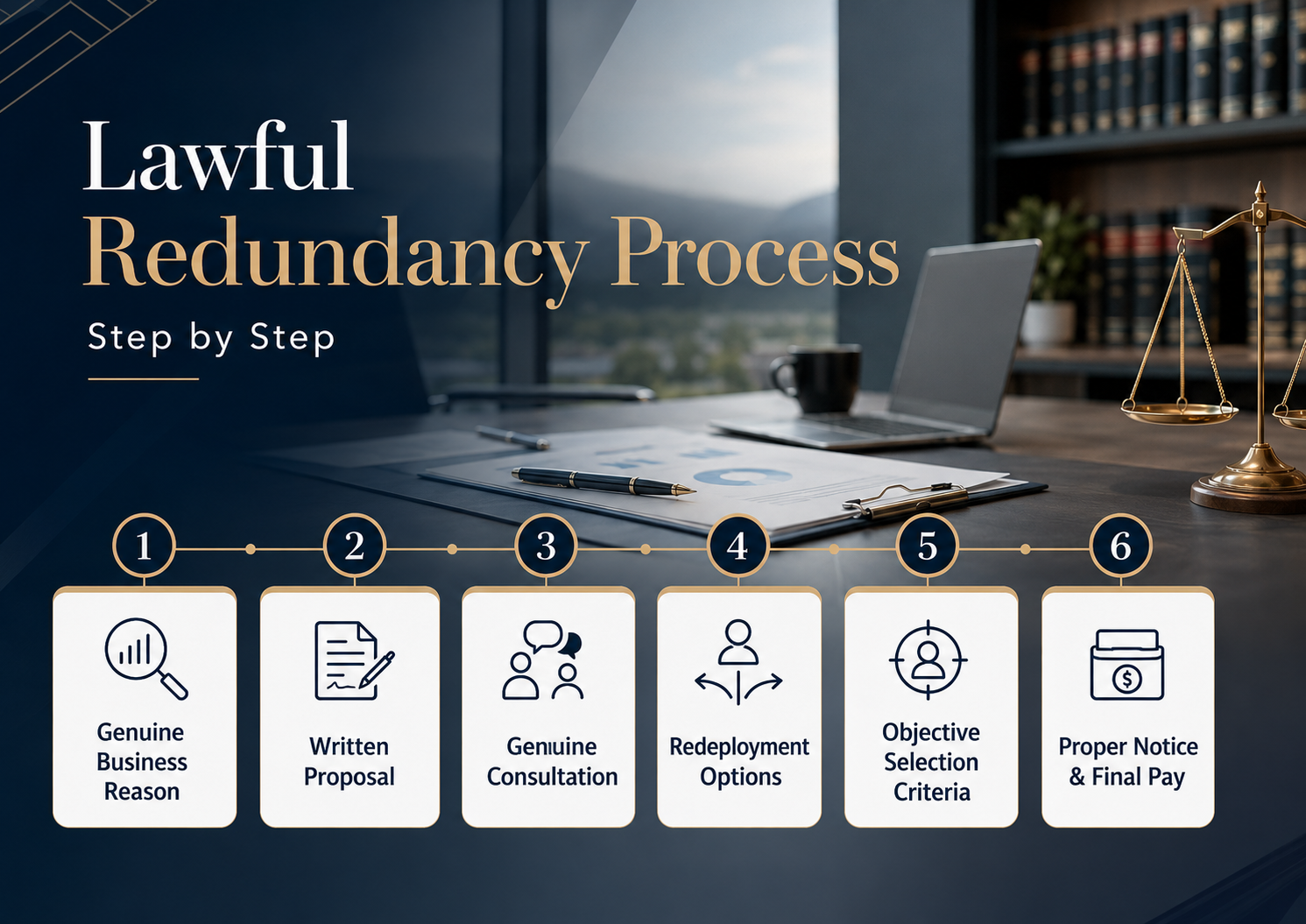
Stage 1: A genuine business reason must exist
Redundancy is about the role — not the person. A genuine redundancy concerns the disestablishment of a position. A dismissal concerns the person’s conduct or performance. Confusing the two is one of the quickest ways to face a personal grievance claim for unjustified dismissal.
The employer must be able to demonstrate a real, documented commercial reason: a contraction in work, cost reduction necessity, restructuring of functions, or a technological change that makes the role genuinely surplus to requirements. “We need to tighten the team” is not a documented reason. A business case, board resolution, or financial analysis is.
Stage 2: A written proposal must be provided before any decision is made
Before anything is decided, the employee must receive a written change proposal that sets out the proposed changes to the business, how those changes affect their role, and what the potential outcomes are — including disestablishment.
This document is the start of a consultation process. It is not a notification of a decision. The proposal stage and the decision stage are legally distinct. An employer who issues a “proposal” and a “decision” simultaneously has not consulted at all.
Stage 3: Genuine consultation — with an open mind
Employers must provide employees with all relevant information about the proposed redundancy, give them a reasonable opportunity to provide feedback on the proposal, and genuinely consider their feedback before making a final decision.
The word “genuinely” carries significant weight here. The ERA looks closely at whether an employer entered consultation with an open mind — meaning the outcome was not already decided. A fair and reasonable employer must go into consultation with a genuinely open mind. If the outcome has already been decided, the process is a sham, and it opens the employer up to a personal grievance claim for unjustified dismissal.
Consultation that gives you 24 hours to respond to a multi-page restructuring proposal, or where your feedback is acknowledged and then immediately disregarded, is not genuine consultation under New Zealand law.
Stage 4: Redeployment must be explored before redundancy proceeds
Before making an employee redundant, an employer must have explored all possibilities to find them another position in the workplace. Ending employment by way of redundancy must be considered a last option.
This obligation is real and enforceable. If there are vacancies within the organisation — even roles at a lower level — the employer must raise them with you and genuinely consider whether redeployment is viable. An employer who moves straight to disestablishment without exploring any alternatives has likely failed this requirement.
Stage 5: Selection criteria must be objective and fair
Where a restructure involves multiple employees and only some roles are being disestablished, the employer must apply consistent, objective selection criteria to determine who is affected. Criteria based on personal preferences, performance perceptions that were never formally raised, or proximity to a manager are all red flags that the selection was not genuinely about the role.
Stage 6: Proper notice and correct final pay
Once a decision is made, the employee must receive written notice of the outcome and be paid for their full notice period. The notice period must be at least the length of notice referred to in their employment agreement or workplace policies. If there is no specified period, ‘reasonable notice’ must be given, taking into account factors such as the employee’s length of service, seniority, and ability to find alternative employment.
What you're actually entitled to be paid
One of the most common sources of confusion in redundancy situations is what employees are — and are not — legally owed.
Whether an employee receives a redundancy payment depends on their applicable employment agreement and any negotiations they’ve had with their employer. If the employment agreement does not mention redundancy pay, then there would be no compensation.
This surprises many people. In New Zealand, there is no statutory minimum redundancy payout. The legal entitlements are your notice pay, your unused annual leave, and any other amounts owed under your agreement. A redundancy compensation payment on top of that only exists if your employment agreement expressly provides for it — or you negotiate for it.
That negotiation is where legal representation makes a real difference.
The sham redundancy — when "restructuring" is just a cover
A sham redundancy arises when an employer claims redundancy as a pretext for dismissal — for example, where duties are merely reassigned or the role is re-advertised soon after the employee leaves. The title may change, but the core function of the role never really goes away.
New Zealand’s ERA and Employment Court take sham redundancies seriously. Real cases confirm this pattern regularly. In one ERA case, a bank employee was found to have been unjustifiably dismissed by redundancy where the employer proposed a restructure that disestablished her team after she raised complaints of bullying and unethical business conduct — with the ERA finding the employer’s actions constituted retaliation.
In another case examined by Lane Neave, the ERA determined that an employee was unjustifiably dismissed, finding that their dismissal was motivated by matters other than genuine commercial considerations. The employer was unable to substantiate their claim that the role was surplus because they did not understand the employee’s duties or the scope of them.
These cases matter because they show that the ERA scrutinizes redundancies closely, and that employers who use redundancy to remove people they simply want gone — without following proper process — face real legal consequences.
What to do if you believe your redundancy was not lawful
If anything about the process described above was not followed — if there was no genuine consultation, if your role has effectively been refilled, if redeployment was never raised, if you were given no meaningful notice — you may have grounds for a personal grievance.
The steps to take are as follows.
First, preserve everything. Keep the redundancy letter, the proposal document, any emails exchanged during consultation, and a written record of what was (and wasn’t) said to you verbally.
Second, seek legal advice immediately. The personal grievance clock starts from the date the redundancy takes effect — and you have 90 days to raise your grievance with your employer. Missing that deadline can permanently close off your options.
Third, do not sign a settlement or exit agreement without legal review. Many employers present these quickly, sometimes with pressure to sign within days. Once signed and countersigned through MBIE mediation, that agreement is full and final — you cannot revisit it. Have it reviewed by an employment lawyer before you put pen to paper.
A note on the 2026 law changes
The Employment Relations Amendment Act 2026, which received royal assent in February 2026, introduced a number of changes relevant to personal grievance claims. The Act states that employees whose annual remuneration meets or exceeds the specified threshold — currently set at NZ$200,000 — may not pursue personal grievances for unjustified dismissal or unjustified disadvantage. For the vast majority of employees earning below that threshold, the existing personal grievance regime remains fully intact.
If you are uncertain how recent legislative changes affect your specific situation, this is another reason to seek early legal advice.
FAQs
My employer said the decision was already made when they “consulted” me — is that legal?
No. Consultation must take place before the decision is finalised, with a genuinely open mind. An employer who has already decided the outcome before consulting has not met the legal standard. This is one of the most common procedural failures in NZ redundancy processes — and one of the strongest bases for a personal grievance.
My role was made redundant, but someone else is now doing very similar work — what does that mean?
It is a strong indicator of a sham redundancy. If the substance of your role has effectively been redistributed or a near-identical position has been created or filled shortly after your disestablishment, the redundancy may not have been genuine. Seek legal advice and document everything you know about what happened to your duties.
Am I entitled to a redundancy payout?
Only if your employment agreement provides for one, or you successfully negotiate one. There is no statutory minimum in New Zealand. However, if the redundancy process was flawed, you may be entitled to remedies through a personal grievance — including compensation for hurt and humiliation and lost remuneration — which can exceed any contractual payout.
My employer gave me 48 hours to respond to the restructuring proposal — is that enough time?
It depends on the complexity of the proposal, but 48 hours is generally very short for a significant restructure affecting your employment. Best practice under NZ law is to provide adequate time to seek independent advice, prepare a response, and genuinely engage. A tight deadline that prevents meaningful consultation is a procedural flaw that can undermine the entire process.
Can I challenge a redundancy if I’ve already signed my exit documents?
If the documents were signed and countersigned by an MBIE mediator, the settlement is likely full and final. However, if you signed an agreement directly with your employer without MBIE involvement, the position may be more complex. Either way, seek legal advice immediately — the window to act may still be open depending on the circumstances.
Your redundancy may not be what your employer says it is
The law in New Zealand is clear: a redundancy is not simply a business decision your employer gets to make unilaterally. It is a legal process — with obligations around genuine reasons, real consultation, redeployment, and fair process — that your employer must meet.
Talk to McKenzie Law before your next move
At McKenzie Law, we represent employees only — and we have seen every variation of a rushed, predetermined, or retaliatory redundancy there is. If you have received a redundancy proposal, if your consultation felt like a formality, or if you believe your role was not genuinely surplus — we want to hear from you.
McKenzie Law is an Auckland-based employment law firm representing employees across New Zealand — including Auckland, Wellington, Christchurch, Hamilton, Tauranga, and all regions. All content is general in nature and does not constitute legal advice. For advice specific to your situation, contact us directly.
