How Mediation Works in Employment Disputes

Ron Mckenzie | June 8, 2026
What to expect at MBIE mediation — and how having representation changes outcomes
You’ve raised a personal grievance. Your employer hasn’t resolved it directly. Someone has mentioned mediation. And now you’re trying to figure out what that actually means — what happens in the room, whether you need a lawyer, whether you should settle, and what comes next if you don’t.
Mediation is the primary dispute resolution mechanism in New Zealand’s employment law system. For most employees with a personal grievance, it is the most important meeting they will attend — often the moment where months of workplace conflict either reach resolution or escalate further. Understanding it properly, and preparing for it seriously, can make a decisive difference to what you walk away with.
This guide explains the full process: what MBIE mediation is, how it works step by step, what the mediator’s role actually is, what happens when mediation fails, and why the decision to bring representation is far more consequential than most employees realise until it is too late.
What MBIE mediation is — and what it isn't
The Ministry of Business, Innovation and Employment runs a free employment mediation service available to any employee or employer in New Zealand with an unresolved employment relationship problem. This service sits at the heart of the Employment Relations Act 2000, which promotes mediation as the primary mechanism for resolving employment disputes — and requires most parties to attempt it before the Employment Relations Authority will formally hear their case.
Mediation is a facilitated negotiation. An independent, government-appointed mediator brings both parties into the same space — either in person or via video — and helps them work toward an agreement. The mediator does not decide who is right. They do not issue a ruling. They do not give legal advice to either side. Their role is to facilitate the conversation, surface each party’s position, and create conditions under which a negotiated resolution might become possible.
This distinction is critical and widely misunderstood. Many employees arrive at mediation expecting a neutral authority figure who will assess the merits of their case and deliver a just outcome. That is not what happens. The mediator’s job is to help the parties reach their own resolution — and if both parties do, the mediator documents and signs it, making it legally binding. If they do not, the mediator moves on. No finding is made. No winner is declared.
Understanding this from the outset changes how you prepare — and it is one of the key reasons why preparation and representation matter so much.
A service under real pressure — what the current wait times mean for you
Demand for MBIE’s mediation service has been climbing sharply and consistently. According to an August 2025 RNZ report, MBIE recorded a 12 percent increase in mediations delivered in the 2024/25 year compared to the previous year, and full-day mediations — which are typically more complex cases — rose by 25 percent over the three years prior. MBIE itself acknowledged that mediators are reporting increased complexity in the issues being brought to them, contributing to longer sessions overall.
The practical consequence is a waiting list that, as of mid-2025, sat at around seven weeks — an improvement from its peak of 11 weeks in February of that year. For employees waiting on a personal grievance outcome, that delay is not a minor inconvenience. It means weeks of continued uncertainty, ongoing contact or conflict with the employer, and time passing on matters that may be time-sensitive.
MBIE does offer an early resolution service for less complex matters, with most of those cases resolved within 15 working days. Urgent matters — such as those involving strikes or collective bargaining — are prioritised. For everyone else, the wait is real, and it is worth knowing your options. Private mediation services are available at cost and can often be scheduled significantly faster. Whether that expense is worthwhile depends on the circumstances — but for employees facing protracted uncertainty, faster resolution frequently has real practical value.
The role of mediation in the NZ employment dispute process
Under the Employment Relations Act 2000, the dispute resolution pathway for most employment grievances follows a clear sequence. The employee first attempts to raise and resolve the issue directly with their employer. If that fails, mediation is the expected next step — and in practice, the ERA will generally require parties to have genuinely attempted mediation before it will schedule a formal investigation meeting.
This means mediation is not truly optional. The ERA has the power to direct parties to mediation even after proceedings have been filed, and it exercises that power regularly. Going into mediation underprepared, unrepresented, or without a clear sense of what you want to achieve is therefore not just an inconvenience — it is a strategic and legal vulnerability at a pivotal point in your case.
How the MBIE mediation process actually works
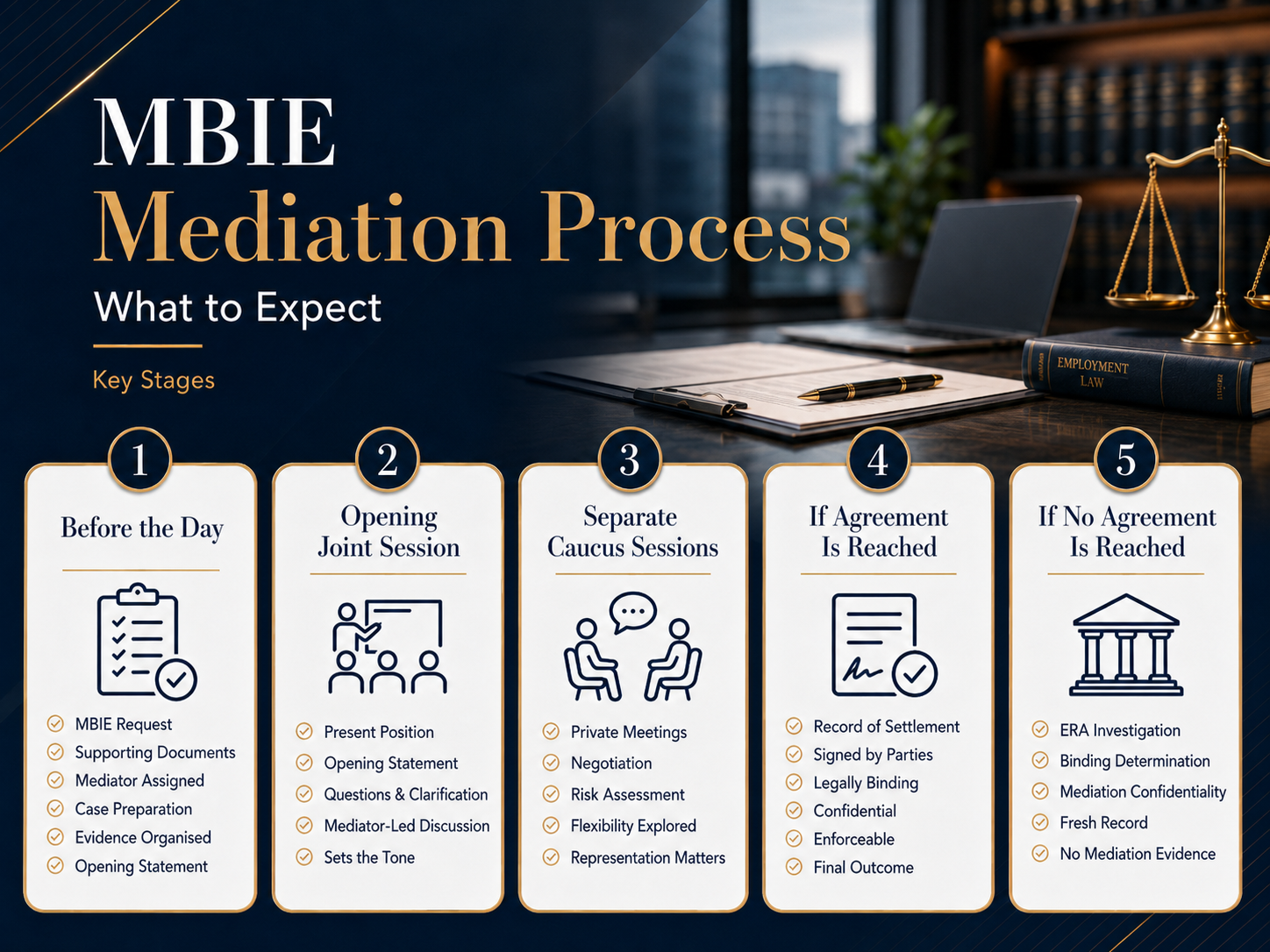
Before the day
The process begins when either party submits a request to MBIE online. You set out the relevant facts in your own words and include supporting documents — your employment agreement, the grievance letter, any key correspondence, and other evidence central to your claim. MBIE then assigns a mediator and schedules the session.
Preparation in the weeks leading up to the session is where much of the real work happens, particularly if you have representation. Your advocate or lawyer will help you develop a clear, structured account of the dispute, organise your evidence, identify the strongest points in your favour, determine the outcome you are realistically seeking, and draft an opening statement. Arriving without having done this work places you at a significant disadvantage — because your employer, particularly if they have HR or legal support, almost certainly will have done it.
The opening joint session
On the day, both parties and the mediator begin together in the same room — or the same video call. Each side is given an uninterrupted opportunity to present their position and state what they are seeking. This is the opening statement phase, and its importance is consistently underestimated by unrepresented employees.
A well-structured opening statement frames the dispute from your perspective before your employer shapes the narrative. It establishes the facts as you understand them, identifies where the employer’s conduct or process was deficient, and signals clearly what resolution you expect. Done properly, it can shift the tone of the entire session and set the terms of the negotiation that follows.
After both sides have presented, there is an opportunity for questions, responses, and clarification. The mediator manages this exchange, keeping the discussion structured and ensuring neither party dominates. This phase can surface new information, reveal weaknesses in the employer’s position, and set the conditions for meaningful negotiation.
The separate caucus sessions
After the joint session, the mediator separates the parties and begins meeting with each side privately. This is the caucus stage — and it is where the substantive negotiation takes place.
In these private conversations, the mediator explores each party’s real position in depth. They test the strength of each side’s case, probe where flexibility may exist, and help both parties think honestly about what the alternatives look like if mediation fails. A skilled mediator will give each side a frank assessment of the risks they face by proceeding to the ERA — because one of their tools is helping both parties understand that a certain, negotiated outcome today is often preferable to an uncertain, expensive, and time-consuming hearing further down the track.
It is important to understand that the mediator is not on your side in these conversations. They are examining your position just as rigorously as your employer’s. Having someone in the room with you who understands employment law, knows how to respond to challenges in real time, and can evaluate any offers made during caucus — that is where having legal representation becomes directly impactful on what you walk away with.
If agreement is reached
When the parties reach a negotiated outcome, the mediator documents the agreed terms in a Record of Settlement. Once all parties have signed it and the mediator has countersigned, it becomes a legally binding, confidential, and enforceable agreement. Neither party can later reopen the matter or raise the same dispute again — the settlement is final.
This finality deserves real attention before you sign anything. A Record of Settlement closes the door permanently on future claims relating to the same matter. The decision of whether to settle, and on exactly what terms, requires careful, informed judgment — ideally with your legal representative guiding you through each offer in real time and helping you understand whether it reflects what your case is genuinely worth.
If no agreement is reached
Not every mediation ends in settlement, and that is a legitimate outcome. If the parties cannot reach agreement, the matter can proceed to a formal ERA investigation meeting, where the ERA hears evidence and issues a binding determination.
Critically, everything said during the mediation session is confidential. Neither party can use it as evidence at the ERA, and the mediator cannot be called as a witness. The ERA starts with a clean record. This means that engaging genuinely in mediation — making offers, exploring resolution — carries no risk to your formal legal position if things do not resolve.
What the mediator will and won't do
One of the most practically important things to understand is the actual scope of a mediator’s role — because many employees arrive with expectations that leave them structurally vulnerable.
A mediator will listen to both sides with genuine impartiality. They will help structure the conversation, manage a difficult dynamic, and facilitate the negotiation. They will often give both parties a realistic sense of where their case stands and what the risks of proceeding look like.
What a mediator will not do is advocate for you. They will not identify your strongest legal arguments. They will not challenge your employer’s position on your behalf. They will not ensure that any settlement you are offered reflects the full weight of your claim. If your employer arrives with a lawyer who presents a carefully prepared case and you arrive alone, the imbalance in that room is real — and the mediator’s neutrality means it cannot be corrected for you.
A landmark case: what the ERA is willing to award
The 2024 ERA decision in Parker v Magnum Hire Limited [2024] NZERA 85 sent a clear signal about the direction of workplace bullying compensation in New Zealand. In that case, a manager who had been subjected to sustained bullying and psychologically abusive treatment by the company’s director over several years was awarded $105,000 in compensation for hurt and humiliation — a figure that drew considerable attention across the employment law community.
The ERA found that the bullying was repeated and unreasonable, that it had caused real and lasting psychological harm including anxiety, depression, and PTSD-like symptoms, and that the employer had failed to provide a safe working environment. Importantly, the ERA noted that the director’s lack of intention to cause harm was irrelevant to the finding of bullying. What mattered was that the behaviour was objectively unreasonable and that harm resulted.
This case matters because it demonstrates that the ERA is prepared to make substantial awards where bullying is serious and sustained — and where the employer failed to take action when they should have. It is not an outlier in isolation. It reflects a broader trend toward higher compensation in personal grievance cases involving genuine harm, and it sets a benchmark that both employees and employers in New Zealand need to understand.
Why representation changes outcomes
The Employment Relations Act 2000 expressly preserves your right to bring a representative to mediation — whether that is a union delegate, an employment advocate, or an employment lawyer. That representative can speak on your behalf, present your opening statement, respond to your employer’s position, assess offers made in caucus in real time, and guide your decision on whether to settle and on what terms.
Employers, particularly larger organisations and businesses with dedicated HR teams, routinely bring professional representation to mediation. They arrive with a prepared position, a clear risk assessment, and a negotiating strategy. An employee who walks in alone — however legitimate their grievance — is negotiating from a structurally weaker position. Not because their case lacks merit, but because the preparation and experience in the room is uneven.
A good employment lawyer or advocate corrects that imbalance. They know what comparable cases have resolved for. They know which aspects of your employer’s process are most exposed to challenge. They can tell you — in the caucus room, in real time — whether an offer is worth accepting, whether you should push further, and what the realistic alternative looks like if you decline. That knowledge has a direct and measurable effect on outcomes.
What to do before your mediation date
Start preparing well before the session. Gather every relevant document: your employment agreement, the grievance letter or notice, all correspondence with your employer, evidence supporting your claim, and a clear written timeline of events. The more organised and thorough your record, the stronger your position when the joint session opens.
Be clear about what you actually want before you walk in. Mediation is a negotiation, and negotiation requires knowing your bottom line in advance. Think about what outcome would genuinely resolve the matter — compensation, a reference, reinstatement, an apology, or some combination — and be clear with your representative about what you are prepared to accept and what you are not.
Seek legal advice before the day if you have not already done so. Even a single pre-mediation consultation with an employment lawyer can clarify the realistic value of your claim, identify the strongest points in your favour, and ensure you go into the room grounded in what is actually achievable rather than what you are hoping for.
And consider the timing carefully. Given current wait times of up to seven weeks for MBIE mediation, the period between now and your mediation date is time that can either be used to build a strong case — or lost through inaction. Use it.
FAQs
Do I have to go to mediation before I can take my case to the ERA?
In almost all circumstances, yes. The ERA expects parties to have genuinely attempted mediation before it will schedule a formal investigation. There are limited exceptions — primarily where a matter is urgent and waiting would cause unacceptable harm — but these are narrow. Treating mediation as an obstacle rather than an opportunity is a strategic mistake that rarely serves employees well.
Can my employer refuse to participate in mediation?
Mediation requires the participation of both parties. An employer who refuses to engage is not in a strong position — the ERA can direct parties to attend mediation regardless, and non-participation reflects poorly in any subsequent proceedings. In practice, most employers do participate, particularly since mediation offers them the same opportunity to achieve certainty and avoid ERA proceedings.
What happens to what I say during mediation if it doesn’t resolve?
Everything discussed during mediation is confidential. If the matter proceeds to the ERA, neither party can refer to what was said, offered, or proposed during the session, and the mediator cannot be called as a witness. This confidentiality is one of the features that makes mediation a relatively low-risk step — you can explore resolution without any of it being used against you at a later hearing.
If I settle at mediation, can I change my mind afterwards?
Once a Record of Settlement has been signed by all parties and countersigned by the MBIE mediator, it is legally binding and final. You cannot reopen the same matter or pursue it before the ERA. This is precisely why the decision to settle — and on what specific terms — must be made with care and with informed advice. Signing under pressure, or without fully understanding what you are agreeing to, is one of the most consequential mistakes employees make in this process.
What if my employer brings a lawyer and I don’t have representation?
You have the right to bring representation, and you should exercise it. If your employer arrives with legal or HR support and you are unrepresented, the practical imbalance in that room is real. If you become aware that your employer will be represented and you are not yet ready, you have grounds to request an adjournment to obtain advice before proceeding. Do not waive that option under time pressure.
Mediation is your best opportunity — but only if you're ready for it
For most employees with a personal grievance, MBIE mediation is the moment that matters most. It is where the large majority of cases resolve. It is where preparation, clarity of position, and the quality of support in your corner directly determines what you walk away with.
Going in underprepared, uninformed, or alone is a choice — and it consistently produces worse outcomes than the underlying strength of many employees’ cases deserves.
McKenzie Law makes sure that does not happen.
Talk to McKenzie Law before your next move
McKenzie Law represents employees only — across Auckland and throughout New Zealand. We attend MBIE mediations regularly. We know how these sessions work, how to build a compelling opening position, how to assess offers in real time, and how to push for outcomes that reflect what your case is actually worth.
If you have a mediation coming up, if you have raised a personal grievance and are unsure what happens next, or if you simply want to understand where you stand before taking your next step — contact us now.
McKenzie Law is an Auckland-based employment law firm representing employees across New Zealand — including Auckland, Wellington, Christchurch, Hamilton, Tauranga, and all regions. All content is general in nature and does not constitute legal advice. For advice specific to your situation, contact us directly.
