
Raising a Personal Grievance in New Zealand | McKenzie Law

Ron Mckenzie | June 30, 2026
If you’ve been unfairly dismissed, disadvantaged, or treated badly at work, you may have grounds to raise a personal grievance. But in New Zealand, timing is everything: in most cases you have just 90 days from when the issue arose (or when you became aware of it) to raise it with your employer. Miss that window and you may lose your right to act altogether.
What counts as a personal grievance?
Under the Employment Relations Act 2000, you can raise a personal grievance if you’ve experienced any of the following:
- Unjustified dismissal, including being forced to resign (constructive dismissal)
- Unjustified disadvantage, where your employer’s actions harmed your employment
- Discrimination, harassment, or bullying in the workplace
- Retaliation for raising health and safety concerns or union activity
The 90-day rule, explained
The clock starts on the date the action happened or the date you reasonably became aware of it. You don’t need to file with a court or tribunal within 90 days, you simply need to raise the grievance with your employer, usually in writing. Late grievances are only accepted in exceptional circumstances, and employers are not obliged to agree.
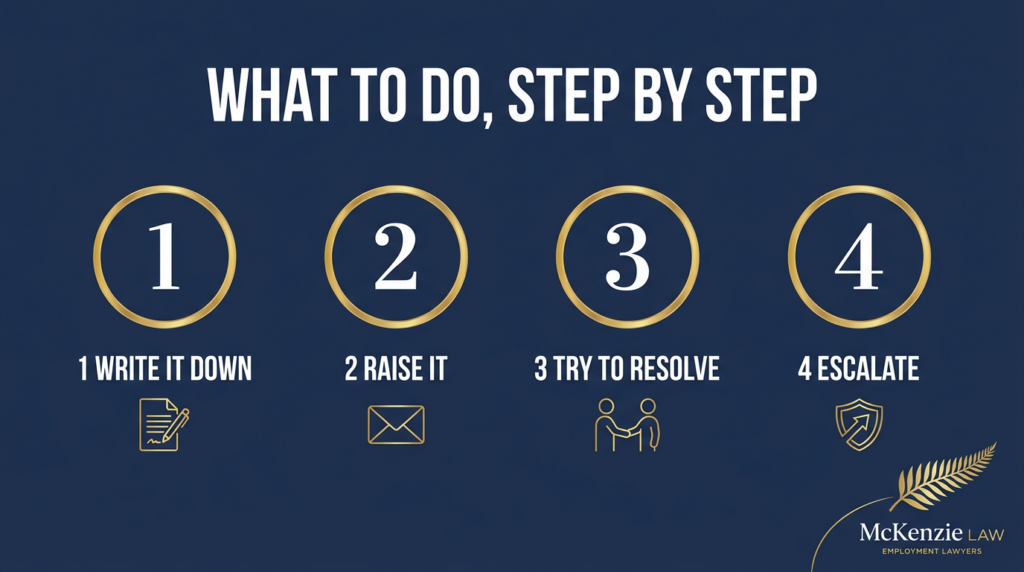
What to do, step by step
- Write it down. Put your grievance in writing, clearly stating what happened and the outcome you’re seeking.
- Raise it with your employer. Send it directly and keep a dated copy.
- Try to resolve it. Many grievances settle through direct discussion or mediation via MBIE’s free service.
- Escalate if needed. If it’s unresolved, you can apply to the Employment Relations Authority.
Don’t wait. The single biggest mistake employees make is letting the 90 days slip while they “think about it.” If something doesn’t feel right at work, get advice early. The sooner you act, the stronger your position.
FAQs
My employer said the decision was already made when they “consulted” me — is that legal?
No. Consultation must take place before the decision is finalised, with a genuinely open mind. An employer who has already decided the outcome before consulting has not met the legal standard. This is one of the most common procedural failures in NZ redundancy processes — and one of the strongest bases for a personal grievance.
My role was made redundant, but someone else is now doing very similar work — what does that mean?
It is a strong indicator of a sham redundancy. If the substance of your role has effectively been redistributed or a near-identical position has been created or filled shortly after your disestablishment, the redundancy may not have been genuine. Seek legal advice and document everything you know about what happened to your duties.
Am I entitled to a redundancy payout?
Only if your employment agreement provides for one, or you successfully negotiate one. There is no statutory minimum in New Zealand. However, if the redundancy process was flawed, you may be entitled to remedies through a personal grievance — including compensation for hurt and humiliation and lost remuneration — which can exceed any contractual payout.
My employer gave me 48 hours to respond to the restructuring proposal — is that enough time?
It depends on the complexity of the proposal, but 48 hours is generally very short for a significant restructure affecting your employment. Best practice under NZ law is to provide adequate time to seek independent advice, prepare a response, and genuinely engage. A tight deadline that prevents meaningful consultation is a procedural flaw that can undermine the entire process.
Can I challenge a redundancy if I’ve already signed my exit documents?
If the documents were signed and countersigned by an MBIE mediator, the settlement is likely full and final. However, if you signed an agreement directly with your employer without MBIE involvement, the position may be more complex. Either way, seek legal advice immediately — the window to act may still be open depending on the circumstances.
Talk to McKenzie Law before your next move
At McKenzie Law, we represent employees only — and we have seen every variation of a rushed, predetermined, or retaliatory redundancy there is. If you have received a redundancy proposal, if your consultation felt like a formality, or if you believe your role was not genuinely surplus — we want to hear from you.
McKenzie Law is an Auckland-based employment law firm representing employees across New Zealand — including Auckland, Wellington, Christchurch, Hamilton, Tauranga, and all regions. All content is general in nature and does not constitute legal advice. For advice specific to your situation, contact us directly.
