
Signs Your PIP Is a Setup — Not a Support Plan

Ron Mckenzie | May 18, 2026
Recognise the difference between genuine performance management and a managed exit
You’ve been handed a Performance Improvement Plan. Your manager called it a development tool. HR described it as a chance to reset. But something about it doesn’t feel right — the targets feel impossible, the tone of every meeting has changed, and the whole thing seems less like support and more like paperwork being built against you.
If that description resonates, trust your instincts. Across New Zealand workplaces, Performance Improvement Plans are increasingly being used not to develop employees, but to engineer a documented path toward dismissal. When that happens, the PIP stops being a legitimate management tool and becomes an unlawful one — and the Employment Relations Act 2000 gives you real grounds to fight back.
This guide will help you understand what a lawful PIP actually looks like, the specific signs that yours may be a setup, and what options are available to you under New Zealand law.
What a legitimate PIP actually looks like
A Performance Improvement Plan, when used correctly, is a structured process designed to give an employee a genuine, supported opportunity to address specific performance shortfalls. Under New Zealand employment law and the good faith obligations of the Employment Relations Act 2000, a lawful PIP must do several things well.
It must be based on specific, documented performance concerns that have been raised with you — not invented at the last minute. The goals it sets must be clear, measurable, and realistically achievable within the time allowed. The employer must commit to genuine support: training, coaching, adjusted resources, and constructive feedback. The timeline must be long enough for real improvement to occur. And the process must be developed with your input, not simply handed to you as a foregone conclusion.
Crucially, the entire process must be forward-looking. A PIP is not a trial by history. It is not an opportunity for a manager to catalogue past frustrations or relitigate old complaints. Once performance expectations and a support plan are set, the focus belongs on what happens from that point forward — not on building a retrospective case for dismissal.
When the plan departs from that standard in any meaningful way, it may no longer be lawful.
The warning signs — is your PIP designed to fail?
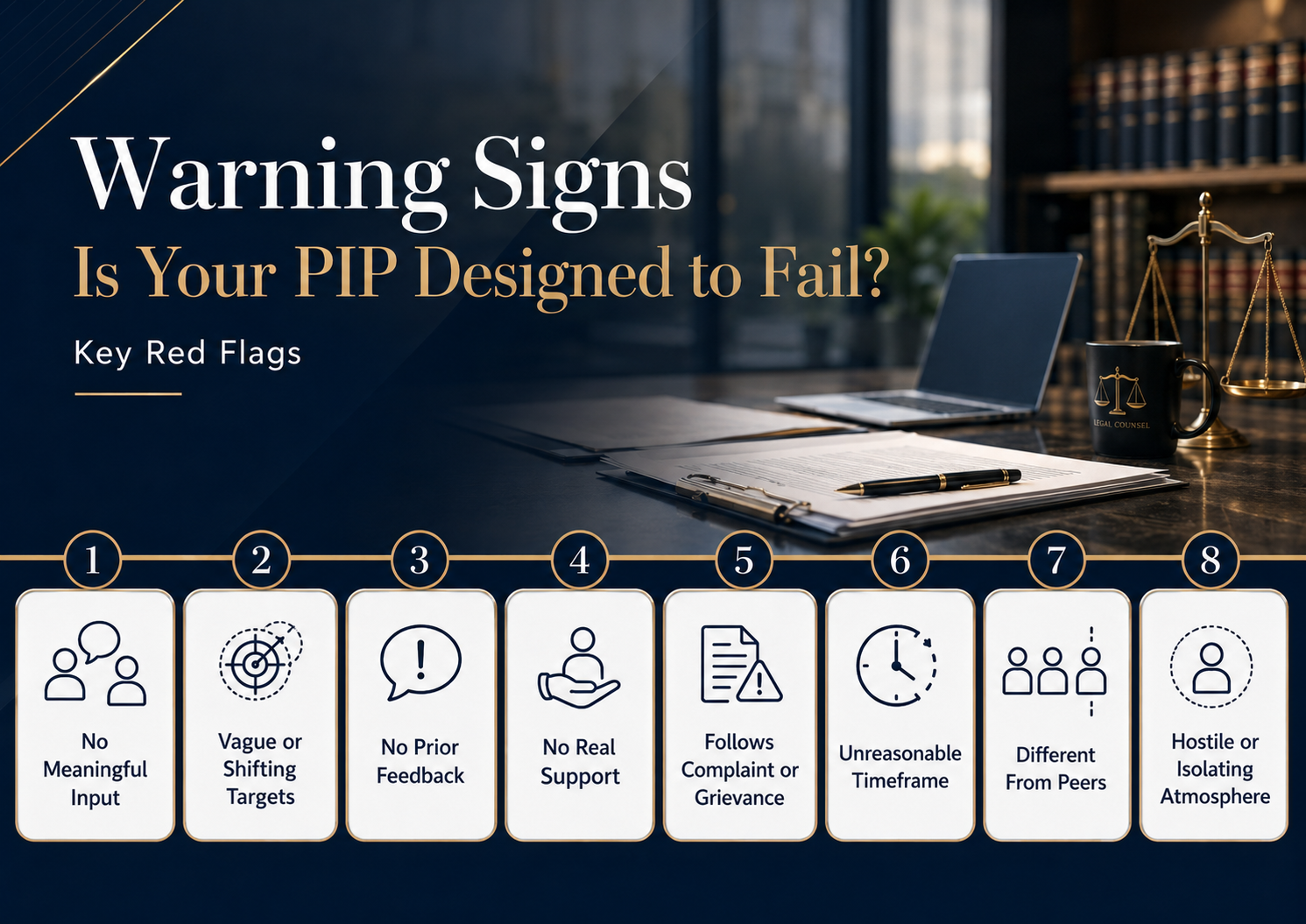
No single warning sign below is automatically conclusive on its own. But a pattern of several of them is a serious indicator that what you are experiencing is not genuine performance management.
You were given no meaningful input into the plan. A lawful PIP is developed with the employee, not at them. If the performance expectations, timelines, and success criteria were handed to you fully formed — with no real discussion, no opportunity to challenge their fairness, and no adjustment based on your feedback — the good faith requirement has already been violated. You were consulted in form only, not in substance.
The targets are vague, keep shifting, or are impossible to measure. If you cannot get a straight answer about what “meeting expectations” actually looks like, or if the definition of success appears to change each time you approach it, the plan was not designed for you to pass. Genuine performance management requires clarity. Ambiguity in a PIP almost always favours the employer — because it allows them to declare failure at any point.
Performance concerns appeared out of nowhere. Fair performance management is a process, not an ambush. Concerns should be raised informally first — a conversation, some coaching, a check-in. If nothing was ever said to you about your performance before this formal PIP landed, ask yourself why something that was apparently never serious enough to mention is now severe enough to put your job at risk. The absence of any prior feedback is itself a red flag that the concern may not be genuine.
The support on offer is superficial or non-existent. An employer who places you on a PIP and then steps back to watch the clock run down has not met their obligation. Real support means actual resources: access to coaching or training, realistic adjustments where structural barriers are contributing to performance issues, and regular check-ins that are constructive rather than adversarial. If the “support” in your plan is a line item that has never materialised in practice, document that gap.
The PIP followed a complaint, a grievance, or a protected action. This is one of the most important warning signs in any employment situation. When a formal performance process appears shortly after you raised a bullying complaint, flagged a health and safety concern, participated in union activity, or took some other protected action, the timing carries legal significance. New Zealand’s Employment Relations Authority looks closely at the proximity between an employee’s protected conduct and a sudden management response. This pattern has been central to successful personal grievance claims before the ERA.
The timeframe is unreasonably compressed. Genuine improvement — particularly in complex skills, relationships, or systemic challenges — takes time. A PIP with a three-week window to demonstrate measurable change in areas that took months to develop is not a support plan. It is a countdown. If your employer has set a timeline so short that failure is structurally inevitable, the plan’s purpose was never improvement.
You are being treated differently from your peers. If colleagues in comparable roles with similar work histories are not subject to the same scrutiny or the same formal processes, that inconsistency matters legally. Performance management applied selectively to one employee, while the same standards are not enforced across the team, can support a claim that the process is being used unfairly — and potentially for an improper purpose.
The atmosphere has become hostile or isolating. A PIP should never become a vehicle for humiliation. If you are being excluded from meetings you previously attended, sidelined from projects without explanation, treated coldly by management, or made to feel like a problem to be managed out rather than a person to be developed — that conduct can constitute workplace bullying independent of the PIP itself, and may form a separate basis for a personal grievance.
What this means legally — your rights under NZ employment law
Being placed on a bad-faith PIP is not merely an unpleasant work experience. Under New Zealand employment law, it may constitute a breach of your employer’s good faith obligations — and it can give rise to a personal grievance without you ever being dismissed.
This distinction matters enormously and is misunderstood by many employees. You do not need to wait until you are fired to act. The Employment Relations Act 2000 recognises unjustified disadvantage as a standalone personal grievance ground. Being subjected to an unfair performance management process — one that damages your reputation, your psychological wellbeing, or your working conditions — is a disadvantage in your employment, regardless of what comes next.
If the PIP does proceed to dismissal and that dismissal is challenged, the ERA will examine both the substantive justification (was there a genuine performance problem?) and the procedural fairness (was the process lawful?). An employer who cannot demonstrate both will struggle to defend the outcome. This is why the quality of the PIP process itself — whether goals were clear, whether support was real, whether timelines were fair — is not just a matter of good management practice. It is legally determinative.
There is also a constructive dismissal scenario to be aware of. If the conduct surrounding your PIP — the isolation, the hostile atmosphere, the impossible targets, the pressure to resign — becomes so intolerable that you feel you have no reasonable choice but to leave, New Zealand law may treat your resignation as a dismissal. Constructive dismissal claims are complex and require strong evidence, but they are a recognised legal remedy in this jurisdiction and have succeeded before the ERA in cases involving sustained workplace pressure.
What to do if you are on a PIP right now
The most important thing you can do is act early — before the process reaches its conclusion, before a decision is made, and before you are placed in a position where your only remaining option is to respond to a dismissal after the fact.
Start by documenting everything. Keep copies of the PIP document, every email, every meeting note, every piece of feedback you receive — and every piece of support that was promised but not delivered. Note dates, attendees, and what was said. A contemporaneous record of the process is one of the most powerful tools available to you if you later need to challenge it.
Seek legal advice before the next meeting. A qualified employment lawyer or advocate can review your PIP, identify whether the process is lawful, help you formulate a written response that protects your position, and attend meetings with you as your representative. What you say and do during a PIP — including how you respond to the plan in writing — can significantly affect the strength of any subsequent personal grievance.
Do not resign under pressure. This is the employer’s preferred outcome in a managed exit situation — because if you resign without legal grounds for constructive dismissal, you walk away with limited recourse. Before you make any decision about your employment, get advice.
Finally, remember the 90-day clock. If you are dismissed following a PIP and believe the dismissal was unjustified, you have 90 days from the date your employment ends to raise a personal grievance with your employer. Missing that window can permanently close off your options. Time matters — act on it.
FAQs
Can I challenge a PIP before it leads to dismissal?
Yes. You do not need to wait to be dismissed to take legal action. Being placed on a bad-faith PIP may itself constitute an unjustified disadvantage under the Employment Relations Act 2000. If the process is unfair, the targets are unreasonable, or support has been withheld, you may have grounds to raise a personal grievance right now — while you are still employed.
My PIP appeared right after I made a complaint about my manager. Is that relevant?
Extremely. The timing between a protected action — such as a bullying complaint, a health and safety concern, or union participation — and a sudden formal performance process is highly relevant to the ERA. This pattern of conduct has supported successful personal grievance claims in New Zealand. Document the timeline precisely and seek legal advice immediately.
What if I genuinely believe my performance has been fine and the PIP is fabricated?
This is more common than many employees realise. An employer cannot simply assert a performance problem — they must be able to substantiate it with evidence. If the concerns in your PIP are exaggerated, mischaracterised, or invented outright, that is a serious procedural and substantive failure. You have the right to respond in writing to every allegation, and your response becomes part of the legal record.
Can I bring a lawyer or advocate to PIP meetings?
Yes. Under New Zealand employment law, you have the right to bring a support person to formal employment meetings, and there is nothing preventing you from bringing a legal representative. Having a trained advocate present changes the dynamic significantly — they can speak on your behalf, challenge unfair process in real time, and ensure nothing is agreed to or signed without your interests being protected.
What if I fail the PIP — is dismissal automatic?
No. Even if you do not meet the targets set in a PIP, your employer must still follow a fair disciplinary process before dismissing you. They must genuinely consider alternatives to dismissal, notify you of the potential outcome, and give you an opportunity to respond. Dismissal is never automatic — and a dismissal that follows a flawed PIP process is more vulnerable to a personal grievance challenge, not less.
A PIP is not the end — unless you let it be
If you are reading this because something about your performance management process does not feel right, take that seriously. New Zealand employment law is built on the principle of good faith — and an employer who uses the PIP process as a managed exit rather than a genuine support mechanism is in breach of that principle.
You have rights. You have options. And the sooner you act on them, the more of those options remain available to you.
Talk to McKenzie Law before your next move
McKenzie Law represents employees only — across Auckland and throughout New Zealand. If you have been placed on a PIP that feels unfair, if the process came out of nowhere, or if you believe you are being managed out, we can help you understand where you stand and what your options are.
McKenzie Law is an Auckland-based employment law firm representing employees across New Zealand — including Auckland, Wellington, Christchurch, Hamilton, Tauranga, and all regions. All content is general in nature and does not constitute legal advice. For advice specific to your situation, contact us directly.
