

What to Do If You're Called to a Disciplinary Meeting

Ron Mckenzie | May 21, 2026
Step-by-step guide to protecting yourself from the moment you receive that letter
You open your email or a letter lands on your desk. It’s from your employer. You’ve been called to a disciplinary meeting.
Your stomach drops. You don’t know what to say, who to call, or whether you still have a job by the end of the week.
This moment — the window between receiving that letter and walking into that room — is the most critical period of your employment dispute. What you do next, and what you don’t do, can determine everything.
This guide is written for employees across New Zealand who find themselves in exactly this position. Whether you’re in Auckland, Wellington, Christchurch, or a smaller town, the same employment law applies to you — and you have far more rights than your employer may want you to know about.
What a disciplinary meeting actually is
A disciplinary meeting is a formal process in which your employer raises concerns about your conduct or performance and gives you an opportunity to respond. Under New Zealand law — specifically Section 103A of the Employment Relations Act 2000 — employers must follow a fair and reasonable process before taking any adverse action against you.
This is not a casual chat. It is a legal process with legal consequences. The outcome could be a written warning, a final written warning, suspension, or dismissal. In some cases, employers use this process not to address genuine issues, but as a mechanism to push employees out.
Understanding the difference between a legitimate process and a weaponised one is essential — and that starts the moment you receive the letter.
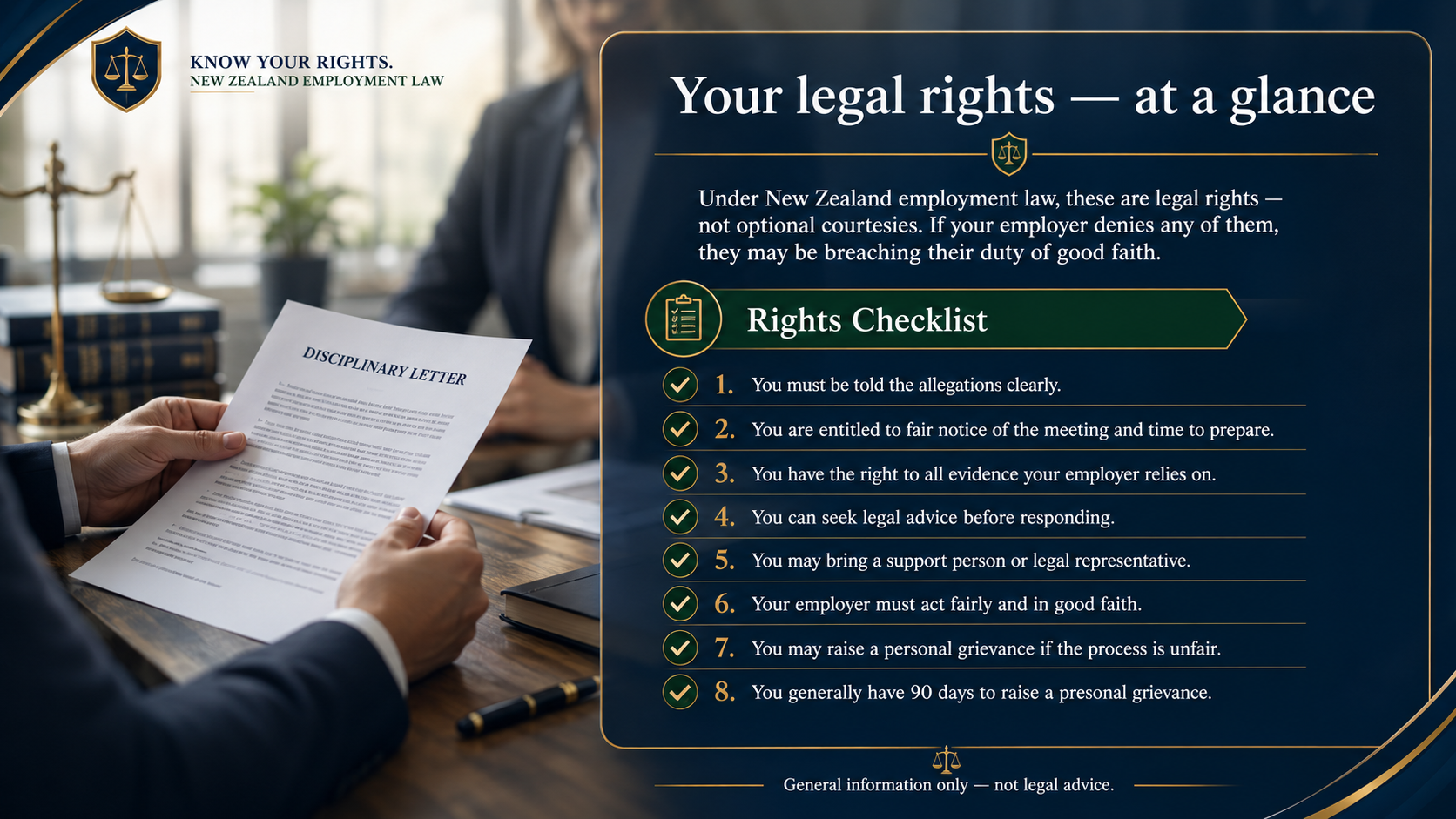
Your legal rights — at a glance
Under the Employment Relations Act 2000 and the principles established through Employment Relations Authority (ERA) case law, you are legally entitled to all of the rights shown in the checklist. These are not optional courtesies your employer extends to you. They are legal obligations. An employer who denies any of them may be breaching their duty of good faith — and that breach can form the foundation of a personal grievance.
When the process itself may be unlawful
Not every disciplinary process is conducted fairly. In fact, many are not. Employers — particularly those acting on the advice of HR consultants who are not lawyers — routinely make procedural errors that undermine the entire process. Some of these errors are genuinely inadvertent. Others are deliberate.
Employers must adhere to procedural fairness, ensuring the employee receives adequate notice of the meeting, access to relevant information, and the right to be accompanied by a support person or representative. When they don’t, they create legal exposure — and you may have a claim regardless of whether the underlying allegation had any merit.
The red flags listed in the visual above are warning signs that the process may be tainted. If you recognise any of them in your situation, you should seek legal advice before the meeting takes place, not after.
What happens after the meeting?
The meeting is not the end. Your employer is required to genuinely consider your response before making any decision. They cannot walk into the room having already made up their mind. Before taking any action against an employee, employers must have a genuine and valid reason.
After the meeting, you should receive a written outcome. If the outcome is a warning or dismissal, you have the right to understand the reasoning. If the reasoning is not provided, ask for it in writing.
If the outcome is dismissal and you believe it was unjustified — whether on the substance of the allegations or due to procedural failures — you have 90 days to raise a personal grievance. Recent Employment Relations Authority decisions continue to confirm that fair process and good faith remain at the heart of New Zealand employment law. Procedural failures by employers are not overlooked — they carry real legal consequences.
Do not resign under pressure
One of the most common mistakes employees make is resigning during or immediately after a disciplinary meeting when they feel cornered, humiliated, or pressured. If you resign, you forfeit most of your legal rights.
There is, however, a legal concept called constructive dismissal — where an employee is forced to resign due to intolerable employer conduct. If your employer’s behaviour made your continued employment untenable, that resignation may still be treated as a dismissal under New Zealand law. But the bar for proving this is high, and you should take legal advice before resigning under any circumstances.
FAQs
Can my employer call a disciplinary meeting without warning?
In principle, yes — but they must still provide reasonable notice of the meeting itself and disclose the allegations and evidence before it takes place. Same-day meetings that deny you time to prepare or obtain advice are a procedural breach. If this happens to you, raise an objection in writing and request an adjournment.
Can I record the meeting without telling my employer?
New Zealand does not have a general prohibition on recording a conversation you are a party to, but covert recording carries risks — including how the recording is received at ERA. The safer approach is to request that the meeting be recorded openly, or to bring a legal representative who takes detailed contemporaneous notes.
What if my employer says I’m not allowed a lawyer, only a support person?
Your employer can place some limitations on who attends, but preventing you from bringing a professional representative entirely may breach your rights depending on the circumstances. The distinction matters most in serious matters involving potential dismissal. Seek legal advice immediately if you are being denied proper representation.
What if I’m on a 90-day trial period?
Valid 90-day trial periods that comply with the Employment Relations Act 2000 enable an employer to dismiss the employee up to 90 days into the employment relationship, and the employee is not permitted to raise a personal grievance for unjustified dismissal. However, you can still raise a personal grievance for discrimination, harassment, or unjustified disadvantage even on a trial period. The trial period clause must also be legally valid — many are not. Have it checked before assuming your rights are gone.
What if I’ve already been dismissed — is it too late?
Not necessarily. You must raise a personal grievance within 90 days of the issue arising or coming to your attention, whichever is later. If you were dismissed last week or last month, you may still be within the window. Contact an employment lawyer immediately to assess your options. Time is the enemy here — do not delay.
A disciplinary letter is not a verdict. It is the beginning of a legal process — one that your employer must conduct fairly, lawfully, and in good faith. If they fail to do that, you have rights. Real, enforceable rights.
But those rights depend on you acting quickly, documenting carefully, and — most importantly — not walking into that room alone.
Talk to McKenzie Law before your next move
At McKenzie Law, we represent employees exclusively. We have over 30 years of experience in New Zealand employment law, and we fight hard for people who are facing exactly what you’re facing right now.
If you’ve received a disciplinary letter, if your meeting is tomorrow, or if you’ve already been dismissed and are wondering what options remain — we want to hear from you.
McKenzie Law is an Auckland-based employment law firm representing employees across New Zealand — including Auckland, Wellington, Christchurch, Hamilton, Tauranga, and all regions. All content is general in nature and does not constitute legal advice. For advice specific to your situation, contact us directly.
