
What Counts as Workplace Bullying in New Zealand

Ron Mckenzie | June 16, 2026
The legal definition, what evidence matters, and your options under NZ employment law
You dread Monday mornings. Your manager picks apart everything you do in front of colleagues. You’ve been left out of meetings, cut off in conversations, and spoken to in ways you would never speak to another person. You go home exhausted — not from the work, but from the environment.
You wonder: does what’s happening to me actually count as bullying? Or is it just a difficult workplace?
That question matters enormously in New Zealand, because the answer determines whether you have legal options — and what those options are. This guide explains how the law defines workplace bullying, what kinds of behaviour qualify, what behaviour doesn’t, what evidence carries weight before the Employment Relations Authority, and what steps you can take right now.
The legal definition of workplace bullying in New Zealand
There is no single Act of Parliament that contains a statutory definition of workplace bullying. Instead, the definition used across New Zealand workplaces, courts, and regulatory bodies comes from WorkSafe New Zealand, and it has been consistently adopted by the Employment Relations Authority in its decisions.
Under that definition, workplace bullying is repeated and unreasonable behaviour directed at a worker or a group of workers that can cause physical or psychological harm.
Three elements of that definition deserve close attention, because each carries legal weight.
The first is that the behaviour must be repeated. A single incident of rudeness, insensitivity, or harsh management — however upsetting — does not typically meet the threshold for bullying under New Zealand law. The behaviour must be persistent, occurring more than once, and often forming a pattern over time. This does not mean every individual act must be severe. A sustained series of smaller incidents can cumulatively constitute bullying even where no single event was extreme.
The second is that the behaviour must be unreasonable. This is assessed against an objective standard — not how the affected employee experienced it, but whether a reasonable person in the same circumstances would view the behaviour as unreasonable. Difficult feedback, high standards, and even robust management styles do not automatically qualify. The ERA has consistently held that strong management is not the same as bullying, and the line between the two matters.
The third is that it must carry the potential to cause physical or psychological harm. This does not mean you must already be suffering a diagnosable condition before you can act. The potential for harm is sufficient. But documented evidence of actual harm — anxiety, depression, sleep disruption, physical symptoms, medical consultations — significantly strengthens any legal claim.
What workplace bullying looks like in practice
Because the definition is deliberately broad, it covers a wide range of conduct. Verbal abuse is the most commonly recognised form — shouting, personal insults, demeaning language, or humiliating someone in front of their colleagues. But bullying is not limited to what is said out loud.
Social exclusion is a less visible but legally recognised form: being deliberately left out of meetings, team communications, or social activities in a way that isolates and undermines the targeted employee. Intimidation — including implied threats about job security, performance consequences, or personal reputation — qualifies. So does the deliberate undermining of someone’s work: setting tasks that are impossible to complete, withholding information someone needs to do their job, or systematically taking credit for their contributions.
Surveillance and micromanagement taken to an unreasonable extreme can also constitute bullying when it crosses from legitimate oversight into a pattern of targeted harassment. The ERA has also recognised bullying that occurs outside the physical workplace — including conduct that spills into after-hours communications or social settings.
What matters in each case is not the label placed on the behaviour, but the pattern, the repetition, and the effect.
What does NOT count as bullying under NZ law
This is a distinction that matters — both for employees assessing their situation honestly, and for employers defending themselves against unfounded claims.
Legitimate management actions are not bullying, even when they are uncomfortable. An employer has the right to set performance expectations, conduct disciplinary processes, give critical feedback, manage workload, and make decisions about roles and structure. Provided these are done fairly, consistently, and in accordance with good faith obligations, they fall within what New Zealand law considers the reasonable exercise of management authority.
Being placed on a performance improvement plan, receiving a formal warning, being made redundant, or being declined for a promotion are not bullying in themselves — though they can become part of a bullying pattern if they are handled in bad faith, applied selectively, or accompanied by conduct that is designed to humiliate or intimidate.
A single incident of poor behaviour, a one-off heated exchange, or an isolated instance of rudeness does not meet the threshold. This does not mean such incidents should be ignored — they can escalate, and documenting them from the start is always advisable — but they do not themselves constitute bullying under the current definition.
The three legal frameworks that apply
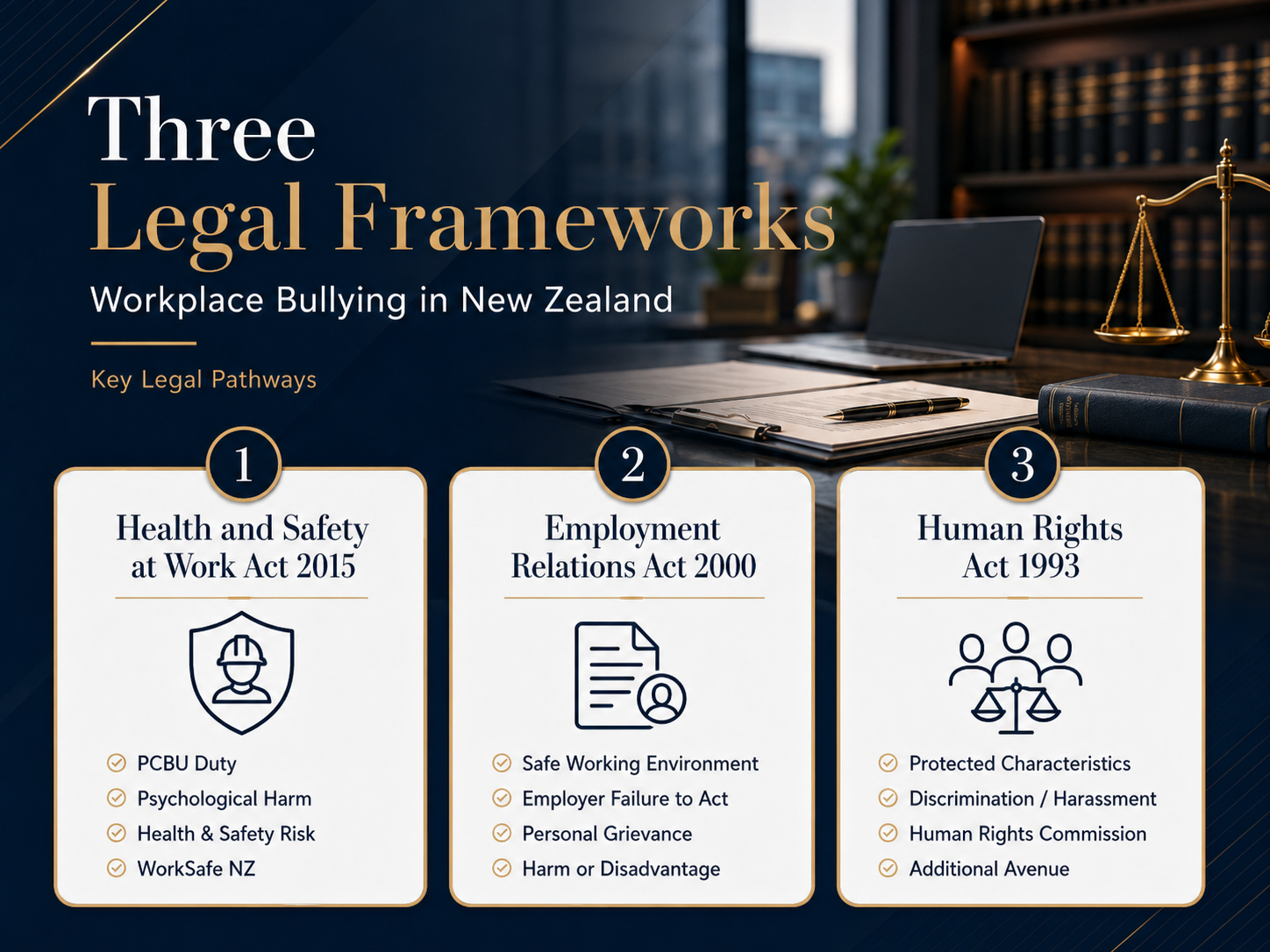
Workplace bullying in New Zealand sits across three separate pieces of legislation, and understanding which one applies to your situation affects what remedies are available and who you make your complaint to.
The first is the Health and Safety at Work Act 2015. Under this Act, every employer — referred to as a Person Conducting a Business or Undertaking, or PCBU — has a duty to eliminate health and safety risks in the workplace so far as is reasonably practicable. Psychological harm from bullying is explicitly recognised as a workplace health risk under this framework. If an employer fails to address known bullying, they may be in breach of their health and safety obligations — and complaints under this Act can be directed to WorkSafe New Zealand.
The second is the Employment Relations Act 2000. Every employment agreement in New Zealand carries an implied obligation that the employer will provide a safe working environment. When an employer fails to address bullying — whether committed by a manager, a colleague, or even a customer — and that failure causes an employee harm or places them at a disadvantage in their employment, a personal grievance can be raised. The bullying itself does not directly give rise to the grievance; rather, it is the employer’s failure to act that forms the legal basis for the claim.
The third is the Human Rights Act 1993, which applies where bullying or harassment is connected to a protected characteristic — race, sex, religion, sexual orientation, disability, age, and others. Where the conduct targeting an employee is discriminatory in nature, this Act provides an additional avenue through the Human Zealand Human Rights Commission.
What evidence matters before the ERA
Evidence is where many bullying claims succeed or fail. The ERA cannot act on a feeling. It needs a record — and building that record is something every employee experiencing bullying should begin as early as possible.
The most valuable evidence in a workplace bullying case is a contemporaneous written record. This means notes made at the time of each incident, not weeks or months later. Record the date, the time, the location, who was present, exactly what was said or done, and how it affected you. The closer to real time these records are made, the more weight they carry.
Written communications — emails, text messages, Slack or Teams messages, and even WhatsApp exchanges — are highly significant. If your manager’s conduct leaves a digital trail, preserve it. Do not rely on having continued access to work systems; save or screenshot relevant communications to a personal device as they occur.
Medical evidence matters, particularly where bullying has caused psychological harm. Records of GP visits, referrals to psychologists or counsellors, any diagnoses, prescribed medication, or periods of sick leave taken as a result of workplace conditions build a compelling picture of the real-world impact of the conduct. The ERA has shown increasing recognition of the seriousness of psychological harm in recent years.
Witness evidence from colleagues who observed the conduct can be powerful — though many employees are understandably reluctant to come forward. Even informal acknowledgements from coworkers that they witnessed certain behaviour, recorded in your own notes at the time, can be useful context.
Documented complaints made to HR or management — and crucially, the response or non-response to those complaints — are also central to any ERA claim. An employer who was put on notice of bullying and took no meaningful action is in a far more legally exposed position than one who investigated promptly and made genuine efforts to address the situation.
A landmark case: what the ERA is willing to award
The 2024 ERA decision in Parker v Magnum Hire Limited [2024] NZERA 85 sent a clear signal about the direction of workplace bullying compensation in New Zealand. In that case, a manager who had been subjected to sustained bullying and psychologically abusive treatment by the company’s director over several years was awarded $105,000 in compensation for hurt and humiliation — a figure that drew considerable attention across the employment law community.
The ERA found that the bullying was repeated and unreasonable, that it had caused real and lasting psychological harm including anxiety, depression, and PTSD-like symptoms, and that the employer had failed to provide a safe working environment. Importantly, the ERA noted that the director’s lack of intention to cause harm was irrelevant to the finding of bullying. What mattered was that the behaviour was objectively unreasonable and that harm resulted.
This case matters because it demonstrates that the ERA is prepared to make substantial awards where bullying is serious and sustained — and where the employer failed to take action when they should have. It is not an outlier in isolation. It reflects a broader trend toward higher compensation in personal grievance cases involving genuine harm, and it sets a benchmark that both employees and employers in New Zealand need to understand.
Your options — what you can do right now
If you believe you are being bullied at work, you have several courses of action available to you, and they are not mutually exclusive.
The first and most important step is to start documenting immediately, if you have not already. Every incident from this point forward should be recorded in writing, with dates and detail. The value of this record compounds over time — it is far harder to dismiss a pattern of documented incidents than a verbal account of events recalled months later.
The second is to raise the issue internally, where it is safe to do so. In some workplaces, a complaint to HR or to a manager above the person responsible for the bullying can result in genuine action. Under the Health and Safety at Work Act 2015, your employer has a legal obligation to take your complaint seriously. How they respond — or fail to respond — becomes part of your evidence.
The third is to seek legal advice before the situation escalates further. An employment lawyer can assess whether what you are experiencing meets the legal threshold for bullying, advise you on whether you have grounds for a personal grievance, help you formulate a formal complaint that protects your legal position, and represent you in any ERA proceedings that follow.
If the situation has made your continued employment intolerable, do not resign without first getting advice. A resignation in circumstances caused by an employer’s conduct — including sustained bullying — may be treated as constructive dismissal under New Zealand law. But that protection is not automatic, and acting without legal guidance can forfeit rights you did not know you had.
Finally, remember the 90-day clock. A personal grievance under the Employment Relations Act 2000 must be raised with your employer within 90 days of the conduct occurring or coming to your attention. In sexual harassment matters, that window is extended to 12 months. Missing the deadline — for any reason — can permanently close off your options. If you are in any doubt about your timeline, seek advice immediately.
FAQs
My manager is aggressive and demeaning in meetings, but only with me. Does that count?
Behaviour that is directed specifically at one employee — rather than being a general management style applied across the team — is a significant indicator of targeted, unreasonable conduct. If the treatment is repeated, consistently harsher toward you than toward colleagues in comparable situations, and is causing you distress or harm, it warrants serious legal consideration. Document each incident and seek advice.
My employer has a bullying policy, but HR hasn’t done anything with my complaint. What can I do?
An employer’s failure to act on a known bullying complaint is a serious problem — both under the Health and Safety at Work Act 2015 and the Employment Relations Act 2000. The existence of a policy that is not enforced does not discharge the employer’s obligations. In fact, being aware of the conduct and choosing not to investigate or act on it can worsen their legal exposure. You can escalate your complaint to WorkSafe New Zealand, or take legal advice about a personal grievance based on unjustified disadvantage.
I work remotely — can I still be bullied, and can I still make a claim?
Yes on both counts. Workplace bullying is not confined to a physical location. Conduct that occurs over email, messaging platforms, video calls, or phone can all constitute bullying if it meets the legal threshold. The same documentation principles apply — save messages, note dates, record what was said. Remote workers have the same legal protections as those working on-site.
Can a colleague bully me, or does it have to be a manager?
Bullying can occur between any people in a workplace — managers, peers, subordinates, clients, or contractors. What matters is whether your employer knew about the conduct and failed to take reasonable steps to address it. An employer who is aware that one employee is persistently targeting another, and does nothing, may be in breach of their duty to provide a safe working environment regardless of the seniority of the person responsible.
I resigned because the bullying became unbearable. Have I lost my rights?
Not necessarily. If your resignation was caused by conduct that made your continued employment genuinely intolerable, New Zealand law may treat it as constructive dismissal — which is a form of unjustified dismissal under the Employment Relations Act 2000. These claims are complex and require evidence that the employer’s conduct left you with no reasonable choice but to leave. The sooner you seek legal advice after resigning, the better — your 90-day window begins from the date your employment ended.
A disciplinary letter is not a verdict. It is the beginning of a legal process — one that your employer must conduct fairly, lawfully, and in good faith. If they fail to do that, you have rights. Real, enforceable rights.
But those rights depend on you acting quickly, documenting carefully, and — most importantly — not walking into that room alone.
Talk to McKenzie Law before your next move
McKenzie Law represents employees only, across Auckland and throughout New Zealand. If you are experiencing bullying at work, if your complaints have been ignored, or if you are unsure whether what you are going through meets the legal threshold — we will give you a straight, honest assessment.
McKenzie Law is an Auckland-based employment law firm representing employees across New Zealand — including Auckland, Wellington, Christchurch, Hamilton, Tauranga, and all regions. All content is general in nature and does not constitute legal advice. For advice specific to your situation, contact us directly.
